 Know Thy Body
Know your tongue
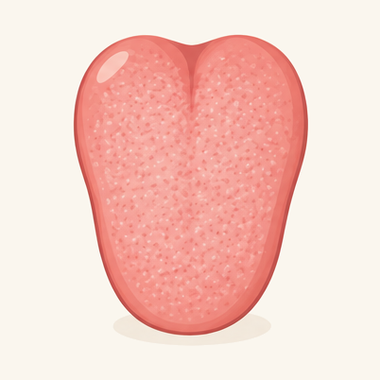
Check your tongue’s color, coating, and texture in the mirror. Pay attention to changes that last several days, and to any pain, sores, or lumps.
- Proper name
- Lingua
- Made of
- Muscle wrapped in mucous membrane
- In short
- Watch changes lasting days, plus sores or lumps
Which one looks like yours?Tap one to see what it means
See all 8 readings
Pink with a thin white coatNormal
Pink with a light, even dusting of white where you can still see the tiny bumps underneath. This is what a typical healthy tongue looks like.
Just keep up daily oral hygiene.
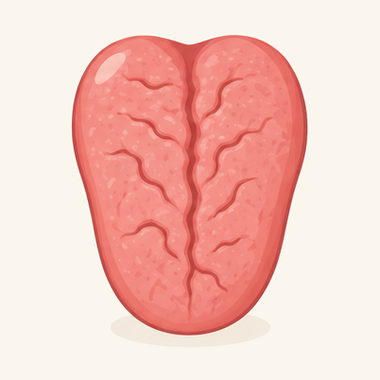
Grooved or crackedFissured tongue · harmless
One or several deep grooves across the top of the tongue. Usually present from birth and more noticeable with age, occurring in under 1% to nearly 30% of people across studies.
No treatment needed. Food bits can catch in the grooves, so brush your tongue gently when you brush your teeth.
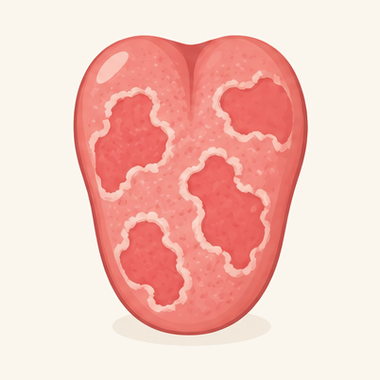
Red patches with white bordersGeographic tongue · harmless
Smooth red patches edged with wavy white lines that shift places over a few days, like a moving map. Found in about 1 to 14 in 100 people, often starting in childhood and sometimes running in families, with no clear cause.
It doesn’t spread and doesn’t turn into cancer. Spicy or piping-hot foods can sting for some people; just avoid whatever bothers yours.
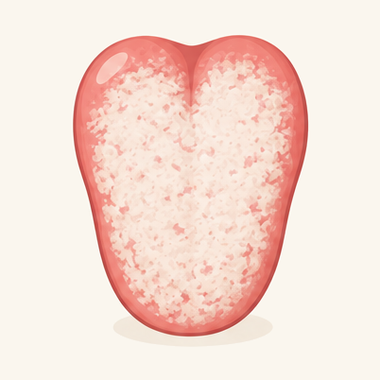
Thick white coatingCommon · usually buildup
A heavy white layer over the tongue from bacteria, food debris, and dead cells caught between tiny bumps (papillae). Dry mouth, mouth breathing, smoking, alcohol, and skipped brushing all thicken it.
Brush your tongue gently when brushing your teeth and drink more water. If it doesn’t fade after a few weeks, see a dentist or doctor.
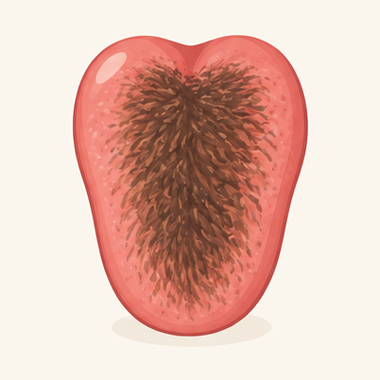
Black hairy tongueLooks alarming · harmless
A dark brown or black furry patch down the middle of the tongue, caused when filiform papillae don’t shed normally, grow extra long, and pick up stains. Common with smoking, strong tea or coffee, poor oral hygiene, or recent antibiotics.
No medical treatment needed. Clean gently once a day with a soft toothbrush or tongue scraper and ease back on smoking, strong tea, and coffee. Bismuth stomach medicines such as Pepto-Bismol can also stain a tongue black temporarily.
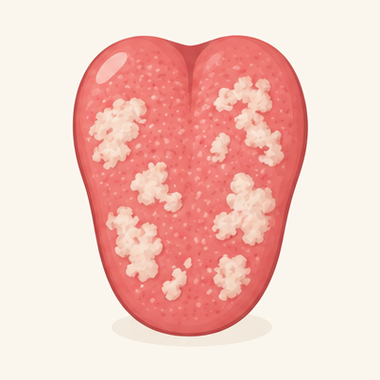
White patches that wipe offPossible oral thrush
White patches over red mouth tissue that leave raw, sometimes bleeding red spots when wiped off. This yeast infection (candida) is common in babies, older adults wearing dentures, people on long courses of antibiotics or steroid inhalers, and people with diabetes.
See a doctor or ask a pharmacist. Always see a doctor for babies under 4 months old, thrush lasting over a week, or pain when swallowing. If white patches won’t wipe off, see a dentist or doctor to check for leukoplakia, which carries a small risk of turning cancerous.
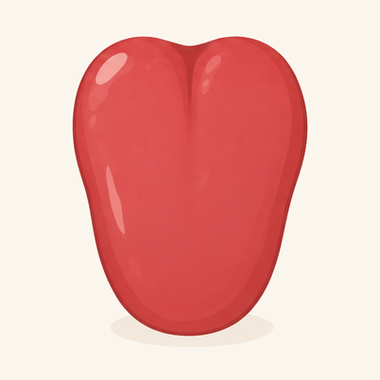
Smooth, glossy, and redPossible nutrient shortage
The tongue turns smooth, shiny, and red with no visible bumps and often feels sore. That happens when papillae shrink away, commonly from low iron, folate, or vitamin B12.
See a doctor for blood tests to check for anemia or low vitamins instead of guessing with supplements.
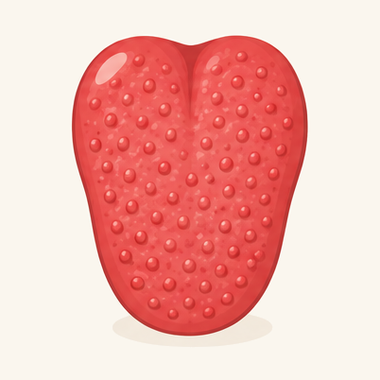
Strawberry tongueSee a doctor in a child
Swollen, bright red, and dotted with raised bumps like a strawberry. Seen mostly in children: in scarlet fever after an early white coat sheds, or in Kawasaki disease alongside a lingering high fever.
If a child has a strawberry tongue, especially with a fever, see a doctor promptly. Scarlet fever needs antibiotics, and a fever lasting 5 days or more calls for checking Kawasaki disease, which can harm the heart if missed.
Your tongue changes daily with food, drinks, brushing, and sleeping with your mouth open. Look for changes lasting several days, or any pain, sores, or lumps.
When to see a doctor
- A mouth sore or ulcer hasn’t healed after 3 weeks
- A red or white patch in your mouth won’t go away, or a white patch won’t wipe off
- You can feel a lump inside your mouth, on your lip, or in your neck or throat
- Mouth pain won’t clear up, you have trouble swallowing or speaking, or your voice stays hoarse
- You’re losing weight without trying
- Your tongue is smooth, red, and sore along with fatigue or pale skin
- A baby under 4 months old has white patches in the mouth, or thrush lasts over a week or makes swallowing hurt
Call an ambulance (911 in the US and Canada, 999 in the UK, 112 in the EU): sudden swelling of your tongue, lips, or throat; fast or labored breathing; or a tight throat making it hard to swallow.
See a doctor urgently: a child with a fever lasting 5 days or more along with a bright red, bumpy “strawberry” tongue, cracked lips, and red eyes. This could be Kawasaki disease, which can damage the heart if not treated early.
Most mouth sores and patches turn out to have everyday causes. During your dental checkup, your dentist can check lingering spots and lumps too.
What your tongue is made of
Your tongue is almost entirely muscle covered by a moist mucous membrane. One group of muscles anchors to bone to stick your tongue out, pull it back, and shift it side to side; another group stays completely inside the tongue to curl, flatten, and point the tip.
That velvety texture on top comes from tiny bumps called papillae. The most common kind (filiform) don’t taste anything at all; they roughen the surface so you can grip and sense food texture. Food bits, shed cells, and bacteria trapped among them form tongue coating.
Taste buds sit inside the other three kinds of papillae. An adult has roughly 2,000 to 4,000 taste buds (older estimates ran as high as 8,000 to 9,000), and their sensory cells renew quickly, swapping out every 1 to 2 weeks.
Your tongue also sits right at the crossroads of digestion and breathing: it pushes food into your esophagus toward the stomach and the small intestine (where iron and B vitamins are absorbed), while air flows past it toward your lungs. Sleeping with your mouth open dries out and thickens tongue coating fast.
- FiliformCover the front of the tongue and make up the vast majority. No taste buds; they give the surface its rough grip.
- FungiformAbout 200–400 scattered across the front, with 3–5 taste buds each.
- CircumvallateOnly 7–12 set in a V at the back, each packed with roughly 200–250 taste buds.
- FoliateAbout 20 ridges lined up along the sides of the tongue.
The “tongue map” is a myth
Sweet on the tip, bitter at the back
Many school textbooks still print a neat “taste map” dividing the tongue into zones. It traces back to a 1901 German study that found tiny differences in sensitivity across parts of the tongue. In 1942, an American textbook redrew that data into a diagram that got misread again and again as “each flavor only works in one spot.”
In truth, all five basic tastes (sweet, sour, salty, bitter, and umami) can be tasted anywhere on the tongue. Real differences are slight: the sides are a bit more sensitive overall, and the back picks up bitterness a little more readily.
And for what it’s worth: spiciness isn’t a taste at all. It’s a pain signal.
Should you scrape your tongue?
Bad breath mostly comes from bacteria breaking down food debris, and the top hiding spot is the back of the tongue.
Dental groups take slightly different views on scraping: some suggest gently cleaning the tongue once a day with a scraper or soft toothbrush (never hard enough to bleed), while others take a more conservative line, noting little proof that tongue brushing prevents bad breath since bacteria grow right back.
Pooling clinical trials shows scraping may give brief, mild relief for bad breath, backed by weak evidence. Gentle cleaning won’t hurt, just don’t expect it to cure chronic bad breath on its own.
Betel quid and areca nut are Group 1 carcinogens. With or without tobacco, chewing areca nut or betel quid causes cancer in humans. Alongside smoking and heavy drinking, it’s a leading cause of mouth cancer.