 Know Thy Body
Know your moles

Nearly everyone has moles, and almost all stay harmless for life. What you want to watch is the spot that’s changing, along with places you rarely look.
- Proper name
- Nevus Naevus
- From
- Clusters of pigment cells (melanocytes)
- In short
- Watch the changing spot, and places out of sight
Check your moles, A through ETap one to see what it means
See all 8 readings
Normal moleNormal
Round or oval, smooth edges, one even color, and roughly the size of a pencil eraser or smaller. It has looked the same for years.
Remember how it looks now. Taking a photo makes it easy to compare later.

AAsymmetryHave a doctor check
If you draw a line down the middle, the two halves don’t match in shape.
See a dermatologist.
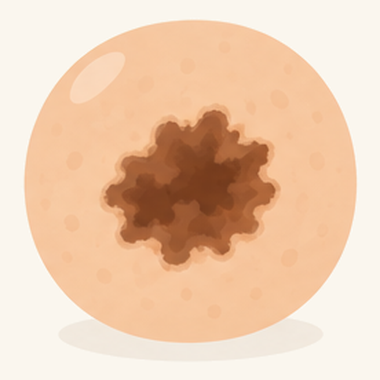
BBorderHave a doctor check
Edges are jagged, scalloped, notched, or blurred so it’s hard to tell where the mole ends and surrounding skin begins.
See a dermatologist.
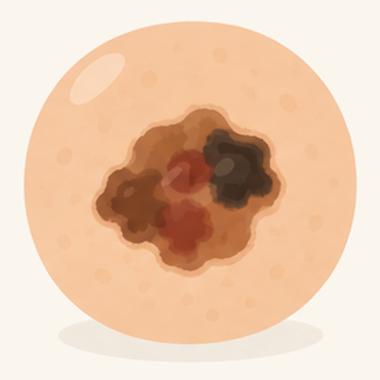
CColorHave a doctor check
More than one color in the same mole: shades of tan, brown, or black, or patches of white, red, or blue.
See a dermatologist.

DDiameterKeep an eye on it
Melanomas are usually wider than a quarter inch (6 mm) when spotted, roughly the size of a pencil eraser, though they can be smaller. Size alone doesn’t mean trouble.
If it’s large and has any other warning sign, or is growing, have a doctor check it.
-
EEvolvingMost important sign
Changing in size, shape, or color, or looking different from all your other moles (the “ugly duckling”). New itching, bleeding, or crusting counts as evolving too.
See a dermatologist promptly. Side-by-side photos are the easiest way to catch changes.
-
Firm, raised, and growingCheck even without ABCD
Nodular melanoma doesn’t follow the ABCD rules: it can be even in color and symmetric, often pink or red, yet raised, firm to the touch, growing over a month or more, and later bleeding or crusting.
See a dermatologist promptly.
-
Palms, soles, or under nailsCheck any new spot
Acral melanoma (on soles, palms, and under nails) isn’t tied to sun exposure and is the most common melanoma in Asian, Black, and Hispanic people. Benign moles on palms and soles are common too.
Have a doctor check any new or changing spot there, or any new dark streak under a nail.
Illustrations are a rough guide only and can’t tell benign from cancerous. Only a dermatologist can diagnose a spot, using a biopsy if needed.
When to see a doctor
- A mole changes in size, shape, or color
- A mole hurts, itches, or becomes inflamed, bleeds, or crusts over
- A new spot appears on your skin and doesn’t fade within a few weeks, including on your palms or soles
- A dark area or streak under a nail that wasn’t caused by an injury
- A new mole appearing in adulthood (some guidance uses age 25 as a rough cutoff)
- One mole that stands out from all your others (the “ugly duckling”)
- A raised, firm lump growing over a month or more, even if it’s one solid color or pink
- A sore that won’t heal, or a removed mole that starts growing back
See a dermatologist promptly: for any of the signs above, especially a changing mole. When melanoma is strongly suspected, quick specialist evaluation matters (many guidelines aim for an appointment within 2 weeks).
Most moles and spots turn out to be benign. Having a dermatologist check gives peace of mind, and if something is serious, catching it early makes treatment far easier.
What moles are
Skin contains pigment-producing cells called melanocytes. When they grow in clusters instead of spreading evenly, you get a mole. About 1% of people are born with a mole (a congenital mole); the rest show up later.
New moles mostly appear from childhood through your 30s or 40s, and some fade or disappear as you get older. Getting new moles as a kid or teen, seeing moles darken slightly during pregnancy, and having them fade with age are all normal.
A typical mole is round or oval with smooth edges, one uniform color, and about the size of a pencil eraser or smaller. On darker skin, moles naturally tend to be darker.
- 10–40Most fair-skinned adults have this many common moles; fairer skin tends to have more.
- 13–16In a study of 115 Han Chinese adults in Henan, average mole counts fell in this range, notably fewer than in European populations.
- 90%Over 90% of adults past age 60 have seborrheic keratoses (“stuck-on” waxy growths that don’t grow on palms or soles). They’re harmless and aren’t moles.
Look at palms, soles, and under nails
Breakdown of melanoma types in a Beijing study of 522 ethnic Chinese patients (41.8% acral, 22.6% mucosal, 35.6% other).
In fair-skinned people, melanoma most often appears on sun-exposed skin. Yet in people of color (Black, Asian, and Hispanic populations), the most common type is acral melanoma, showing up on the soles of the feet, palms of the hands, and under the fingernails or toenails. In the Beijing study above, acral melanomas made up over 40% of cases (and nearly two-thirds when combined with mucosal melanomas in the mouth or nose). Japanese registry data shows the same pattern, with the sole of the foot as the top site. Sun exposure isn’t the main driver here.
The catch is that few people think to inspect their soles or under their nails, so early spots are often brushed off as a callus, wart, bruise, or nail fungus. In that Beijing study, 5-year survival was only about 42%, far below the roughly 91% seen overall in US data, largely because it’s caught late.
At the same time, don’t panic: benign moles on the palms and soles are common, and not every dark mark is cancer. Just have a doctor check any new spot on your palms, soles, or under a nail, or any spot that’s changing. For dark lines on nails, see Know your nails.
Who has a higher risk
- Sunburns, heavy sun exposure, or tanning beds
UV radiation is the leading cause of melanoma. Childhood sunburns carry heavy weight, though more sunburns at any age raise your risk. - Having many moles
Having over 100 moles raises risk sharply: in a pooled analysis, people with 101–120 moles had nearly 7 times the risk of those with fewer than 15. - Atypical (dysplastic) moles
The more uneven-looking moles you have, the higher your overall risk, though any single atypical mole rarely turns cancerous on its own.
- Family history
Roughly 1 in 10 people with melanoma has a family history of it. - Fair skin that burns easily
People with darker skin have a lower overall risk, though the risk isn’t zero. - Very large congenital moles
Giant moles present at birth expected to reach more than 8 inches (20 cm) across in adulthood carry higher risk (estimates range from under 1% up to 5–10%); smaller ones under palm size carry very low risk.
About mole removal
Removing a mole prevents cancer
Normal moles don’t need to be removed, and removing them doesn’t prevent melanoma: most melanomas grow on previously normal skin rather than from an existing mole.
When a suspicious mole needs to come off, a doctor should excise the whole spot and send it to a lab for biopsy. Burning or lasering it off destroys the tissue so a pathologist can’t check it properly; if that mole happened to be melanoma, leftover cells can keep growing and spreading while diagnosis is delayed. Never try to remove a mole at home. If a removed mole starts growing back, go back to your doctor right away.
Does scratching or nicking a mole turn it into cancer? The evidence is mixed: a German study of 369 patients found no link between trauma and melanoma, while case series of acral melanoma in China noted many patients recalled past injuries, though recall studies can’t prove cause and effect. A practical approach: ask a doctor to properly remove a mole that keeps catching on clothes or razors, and either way, have a doctor look at any changing mole.
Skin checks & sun protection
 Check head to toe regularlyOnce a month (some dermatologists suggest every 3–6 months). Use a full-length mirror and a hand mirror, and don’t skip your scalp, back, buttocks, between your toes, soles, and bare nails without polish. Ask someone close to check spots you can’t reach.
 SunscreenChoose broad-spectrum sunscreen, SPF 30 or higher (SPF 50+ for long days outside), and apply evenly to any skin clothing leaves uncovered.
 Shade and clothing firstSeeking shade, wearing long sleeves, and putting on a wide-brimmed hat protect better than sunscreen alone. Use sun protection whenever the UV index is 3 or higher, limit midday sun, and avoid tanning beds.
Take clear photos of your moles so you can compare side by side later and spot any change early.