 Know Thy Body
Know your nails
Nails grow slowly, so a fever or bump from weeks ago leaves its mark as it moves outward. Most nail changes are harmless, though a few are worth showing a doctor.
- Proper name
- Nail plate Unguis
- From
- The nail matrix beneath the base
- In short
- How many half-moons you see says nothing about health
Which one looks like yours?Tap one to see what it means
See all 8 readings
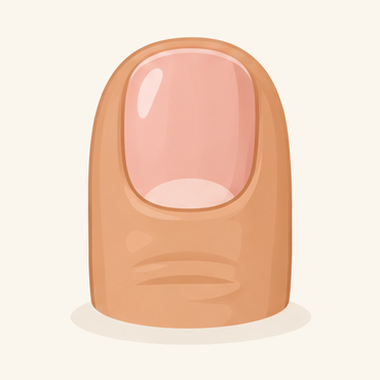
Smooth and pinkNormal
Smooth and pink, with a pale crescent (lunula) at the base. That half-moon is just the visible edge of the nail matrix; not seeing any is completely normal.
Keep them clean, dry, and trimmed short.
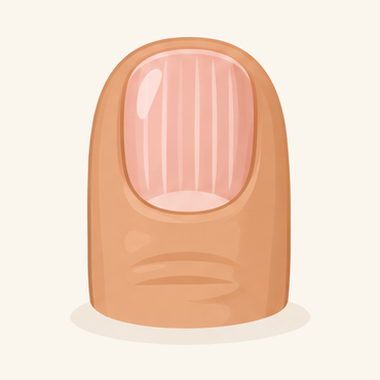
Vertical ridgesCommon · usually age
Fine lengthwise lines running from base to tip. They get more noticeable with age and are a normal part of aging nails.
Nothing to worry about.
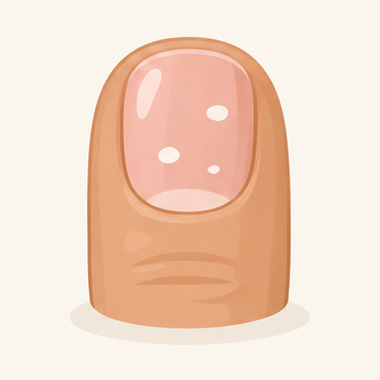
White spotsUsually minor bumps
A few scattered white dots almost always come from minor bumps (biting your nails, manicures, tight shoes, or a knocked finger), not calcium or zinc deficiency. They grow out slowly over about 6–9 months on fingernails.
Leave them alone. If white marks cover most of the nail, or the nail turns half white and half brown-red (sometimes linked with liver or kidney trouble), ask a doctor.
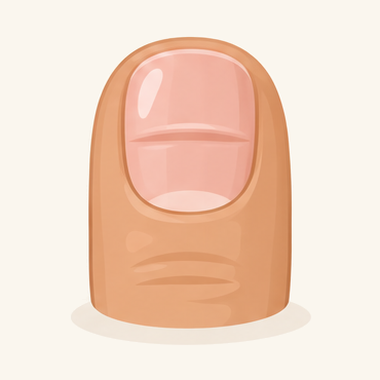
Horizontal grooveGrowth paused briefly
A dent running side to side across the nail (Beau’s line) shows growth briefly stopped, often after a high fever, illness, injury, chemotherapy, or severe stress. On many nails at once, it points to a body-wide illness.
It will slowly grow out. Its distance from the base gives a rough clue to how many weeks ago it happened; see a dermatologist if there’s no clear cause.
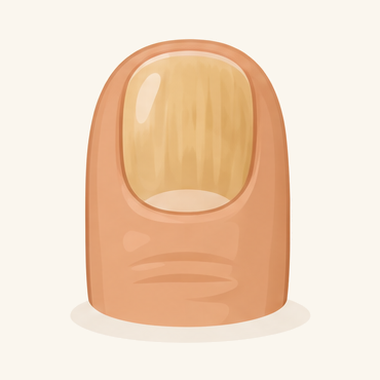
Thick and yellowPossible fungal infection
Yellow, thickened, crumbly nails are most often caused by a fungal nail infection, especially in older adults, athletes, and people with diabetes. Smoking and dark red polish without a base coat can also stain nails yellow.
If you suspect nail fungus, ask a doctor or pharmacist about treatment.
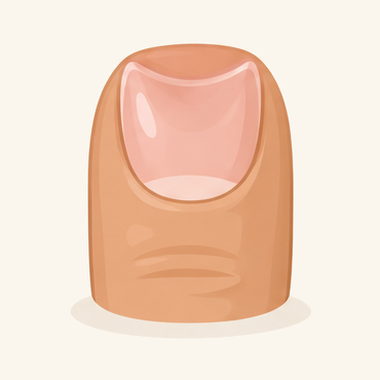
Spoon-shapedPossible low iron
Nails that dip in the middle and curl up at the edges like a spoon (koilonychia) can be a sign of iron-deficiency anemia. Babies sometimes have thin, spooned nails naturally that flatten out over a few years.
See a doctor for a blood count and iron check before taking iron supplements on your own.
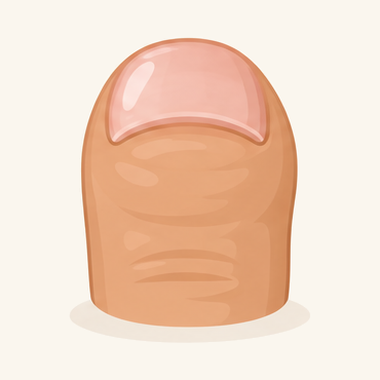
ClubbingSee a doctor
Rounded, soft fingertips with nails curving downward over the tip. It can link to lung, heart, liver, or gut conditions, though it can also run harmlessly in families. Quick check: press the backs of matching fingernails together; normally a tiny diamond window appears, which disappears with clubbing.
If clubbing is new, see a doctor to check the cause.
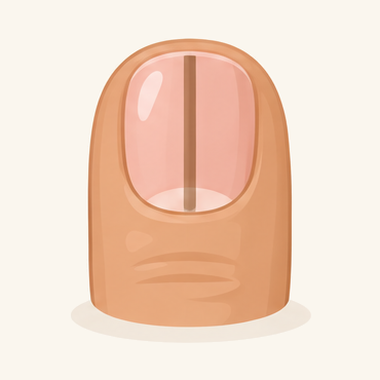
Dark vertical streakNew or changing · see a dermatologist
A brown or black stripe running base to tip. Common and usually harmless pigment in East Asian, Black, and Hispanic people, though it can also be nail melanoma.
See a dermatologist promptly if it’s new, widening or darkening, on only one nail, or spreading onto surrounding skin. See the ABCDEF guide below.
Nail changes take weeks to months to show up and just as long to grow out. When unsure, take photos a few weeks apart to compare.
When to see a doctor
- A new dark streak appears on a nail, or an existing streak gets wider, darker, or uneven in color
- Dark pigment spreads onto the skin around the nail
- Your nails change shape or color, or lift off on their own, with no obvious reason
- Fingertips thicken and nails curve sharply downward (clubbing)
- Skin around a nail is red, swollen, warm, painful, or oozing pus
- An ingrown toenail is swollen and painful, draining pus, or comes with a fever
- Any nail problem if you have diabetes or poor circulation
See a dermatologist promptly: a new or changing dark streak under a nail, or dark pigment spreading onto surrounding skin.
See a doctor urgently: an ingrown toenail if you have diabetes, or any ingrown nail with pus or a high fever.
Most nail changes turn out to be harmless. If you’re not sure whether something is shifting, take clear photos every few weeks and bring them to your appointment.
How nails grow
Nails are hard plates of keratin pushed forward layer by layer from the nail matrix tucked under the skin at the base (about 90% of the nail plate grows from there). The pale half-moon (lunula) at the base is simply the part of the matrix you can see. The cuticle acts like a waterproof seal keeping out bacteria and irritants.
Fingernails grow faster than toenails; the pinky is slowest and the big toe is fastest among toes, and growth slows with age. Lose a whole nail, and a fingernail takes around 6 months to grow back, while a toenail can take up to 18 months.
That’s why a horizontal groove lets doctors estimate roughly how many weeks ago your body went through a major illness or stress, based on how far it sits from the base.
- 0.14 inYoung adults’ fingernails grow about 0.14 inches (3.5 mm) a month on average, roughly 0.04 inches (1 mm) every 6–10 days.
- 0.06 inIn the same study, toenails grew about 0.06 inches (1.6 mm) a month on average, less than half as fast.
- 6 monthsAbout 6 months (some sources say 6–9 months) for a lost fingernail to grow all the way back.
- 18 monthsUp to 18 months for a lost toenail to grow all the way back.
Half-moons have nothing to do with health
More half-moons = healthier
Everyone has a lunula; it’s just the visible edge of the nail matrix, and in some people most of it sits tucked under the skin. Thumbnails usually show the largest half-moon, they shrink with age, and seeing none at all is completely normal. There is no healthy quota for how many half-moons you should have, and the number doesn’t measure overall health.
What actually deserves attention are rare shifts in lunula color or the nail bed itself: red half-moons can link with heart failure or lupus, blue ones with Wilson’s disease (copper buildup) or silver toxicity, while nails turning mostly white or half white and half brown-red can point to chronic liver or kidney disease. All of these are rare and usually come with other symptoms; half-moons alone never diagnose a condition.
Dark streaks on your nails
A brown or black vertical band running from base to tip is called longitudinal melanonychia. It’s very common in people with darker skin tones and East Asians (seen in up to roughly 20% of people in Japanese population surveys), and the vast majority are harmless pigment.
Still, it can occasionally be subungual (nail) melanoma. While nail melanoma makes up only a small share of melanomas in white people, it accounts for a much higher share in Asian, Black, and Hispanic populations. In a predominantly Chinese series from Singapore, about 4% of biopsied dark nail streaks turned out to be melanoma, with higher risk past age 50. In children, dark nail streaks are rarely cancerous.
A dark purple or black patch after slamming a finger or dropping something on a toe is a subungual hematoma (bruise under the nail): within weeks, clean nail grows in behind it and pushes the dark spot forward. If the base stays black and doesn’t move out with the nail, have a doctor check it. See Know your moles for other skin-check signs.
The ABCDEF guide dermatologists use
- AAge: most common between ages 50–70; nail melanoma makes up a larger share of melanomas in Asian, Black, and Hispanic populations.
- BBand: brown to black pigment, about 1/8 inch (3 mm) or wider, with blurred or uneven borders.
- CChange: the streak grows wider or darker, or the nail plate itself splits or breaks down.
- DDigit: most often the thumb or big toe, followed by the index finger; usually just one nail.
- EExtension: dark pigment spreads onto the skin around the nail.
- FFamily or personal history: you or a close relative have had melanoma.
These are warning signs only; diagnosis takes a biopsy. Also, up to about half of nail melanomas have little or no dark pigment.
Everyday nail care
- Cut toenails straight across
Trim them straight, not too short, and don’t round or dig into the corners; that helps prevent ingrown toenails. Fingernails can be gently rounded at the tip. - Don’t bite nails, pull hangnails, or cut cuticles
All three break the skin seal around the nail and invite painful nail-fold infections (paronychia). - Keep hands dry when you can
Bacteria and fungi love dampness, and skin conditions like psoriasis or fungal infections on the scalp can affect nails too. Wear gloves for dishes and cleaning; constant soaking makes nails soft and brittle.
- Brittle, splitting nails
Very common, affecting up to 1 in 5 people and especially women over 50. Frequent wet work and harsh cleansers are common culprits; cut back on soaking. - Biotin (vitamin B7)
Small studies suggest it might help brittle nails, though solid proof is lacking. Important catch: high-dose biotin can throw off lab blood tests, including troponin tests used to spot heart attacks, so tell your doctor before any blood draw. - Nail polish
Constant polish and frequent soaking can make nails brittle, and dark red polish without a base coat can stain nails yellow.